
Exposed Aggregate in Pakenham
Exposed aggregate is what a concrete driveway looks like after you take the top 2 mm off it. What you’re seeing is the stone that was there the whole time — retarded on the surface, washed off before it sets, and sealed to keep the colour it had on day one.
Done well, it lasts thirty years and grips a sloping driveway in wet weather better than any other domestic finish. Done badly, it goes patchy in the sun, sheds stones under a hosed footpath, and looks tired by year five. This page explains the difference.
The aggregate is the design choice
Everything about an exposed aggregate driveway — how it reads, what it costs, how it ages — comes down to two decisions about the stone. What it is, and how much of it you see.
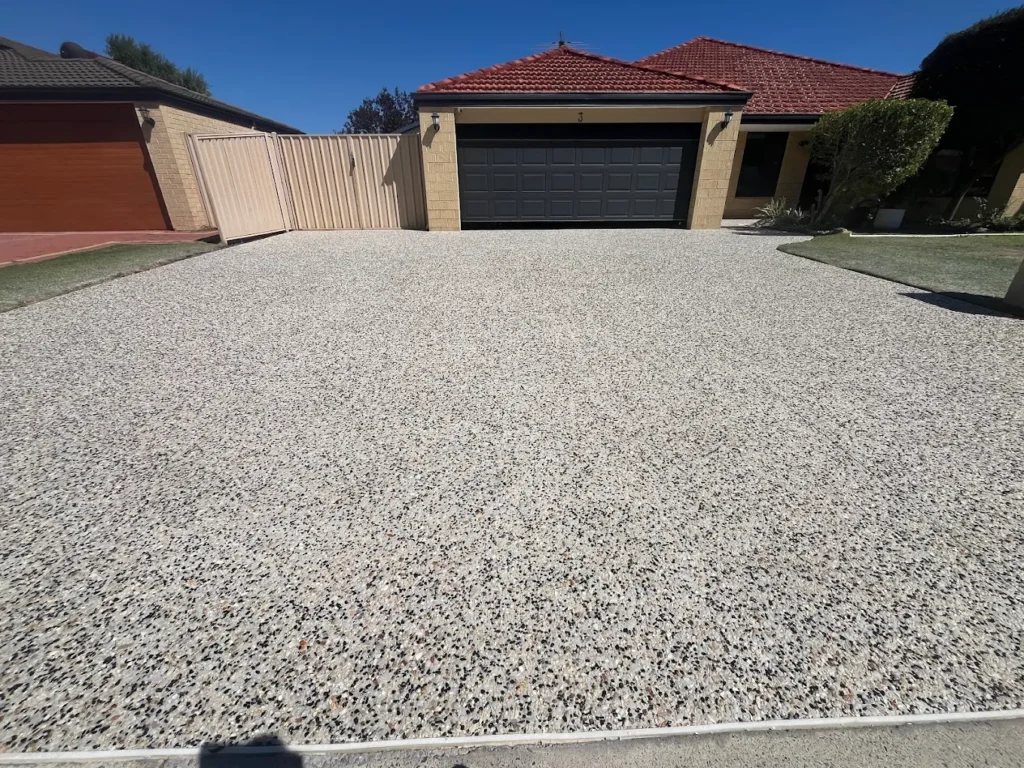
Aggregate types
The common finishes across the corridor:
- Local river pebble — rounded, warm tones, the standard budget option. Reads soft, feels comfortable underfoot.
- Basalt (blue metal) — grey to charcoal, hard, angular. Contemporary. Common in newer estates.
- Granite — speckled black, grey, pink or gold depending on quarry. Harder wearing than river pebble, more expensive.
- Quartz and reconstituted stone — premium finishes, brighter, near-white or ivory. Real colour, real cost.
Suppliers around Melbourne offer these in 7 mm, 10 mm and 14 mm sizes. 7 mm reads as a fine, dense surface. 14 mm reads as a coarser, more textural one. 10 mm is what most driveways in the growth corridor end up with, and it’s the size the standard mixes are dosed for.
Depth of exposure
Once the aggregate is chosen, the second decision is how proud it sits.
- Light exposure — the tops of the stones show. Finish reads as textured but flat under a boot.
- Medium exposure — roughly a third of the stone visible. The standard finish, and what most decorative driveways in Pakenham are.
- Heavy exposure — up to half the stone showing. Bolder, more tactile, and the option that best suits a sloping driveway because there’s more grip.
Heavy exposure isn’t better; it’s a different look. What matters is that we agree the depth before the pour, because the retarder is dosed and the wash is timed to hit it.
How the finish is actually produced
The base slab is a standard reinforced driveway or path — site-classified, reinforced, jointed, poured to the same standard as any other slab we build. The finish is what happens in the two hours after the concrete goes down.
Surface retarder
A liquid surface retarder is sprayed onto the wet concrete after finishing. It stops the cement paste at the very top of the slab from hydrating for a set window — typically 4 to 24 hours depending on the product and the depth of exposure it’s dosed for.
The concrete underneath cures normally. Only the top skin stays soft.
The wash window
This is the part that decides whether the driveway looks right. Once the slab underneath has set enough to hold the stones but before the retarded skin has re-cured, we wash and brush the surface. The unhydrated cement comes off; the aggregate underneath is left proud.
The window is roughly two hours wide. Wash too early, stones come out. Wash too late, cement doesn’t shift and you get a patchy, milky finish that no amount of sealing hides.
Weather changes the window. A cool overcast day gives you more time; a hot easterly cuts it in half. On the day of the pour, the timing is judged by touch and by how the retarder is releasing — not by the clock.
Cure, seal, hand over
This is the part that decides whether the driveway looks right. Once the slab underneath has set enough to hold the stones but before the retarded skin has re-cured, we wash and brush the surface. The unhydrated cement comes off; the aggregate underneath is left proud.
The window is roughly two hours wide. Wash too early, stones come out. Wash too late, cement doesn’t shift and you get a patchy, milky finish that no amount of sealing hides.
Weather changes the window. A cool overcast day gives you more time; a hot easterly cuts it in half. On the day of the pour, the timing is judged by touch and by how the retarder is releasing — not by the clock.
Slip resistance: the standard nobody names, and why it matters here
AS 4586 is the Australian Standard for slip resistance of pedestrian surfaces. It classifies a finish from P0 (no grip) through P5 (very high) for wet ramp conditions. It exists for a good reason: a smooth-troweled sloping driveway in Pakenham’s winter is a legitimate hazard.
Medium and heavy exposed aggregate generally test in the P4 to P5 range, which is why the finish is common on driveways that fall toward the street — almost every driveway in Cardinia Lakes, Arcadia or Timbertop qualifies.
Two things worth knowing. First, the sealer coat matters: aggressive high-gloss sealers reduce the slip rating. We use products classified for external use with the finish rating intact. Second, if slip resistance is a specific requirement — commercial, disability, insurance — we can specify a tested product and provide the classification with the quote. It isn’t standard for a residential driveway, but the option is there.
Colour, ageing, and the two-year problem
The most common complaint about exposed aggregate isn’t the pour or the wash. It’s what happens two years in.
Cement paste around the aggregate efflorescences — salts move to the surface, dry, and leave a white haze. Sealer wears through in the wheel tracks and the colour goes flat where the driveway sees the most weather. Neither is a defect. Both are decisions you make about upkeep.
The maintenance is a reseal every 3 to 5 years. It’s a two-hour job on a domestic driveway and it’s what keeps the finish looking the way it did on day one. If you don’t want to reseal, exposed aggregate isn’t the finish for you — a plain broom-finished slab or a coloured concrete without exposure needs less attention. See decorative concrete for those options.
Where exposed aggregate meets the road reserve
One place the finish stops. If your driveway continues into a Council vehicle crossing, the crossover section has to be Council-approved for coloured or decorative concrete, and the minimum strength rises to 32 MPa in the road reserve regardless of the finish on top.
Practically that means the driveway on your land can be one specification and the crossover can be another — both engineered separately, priced separately, and matched visually where they meet. The detail is on the vehicle crossing page.
Where we work
Exposed aggregate is the most-requested finish across the growth-corridor estates. If you’re in a covenant-controlled estate — and a concreter in Officer deals with these constantly — check your title documents for the driveway finish requirements before choosing an aggregate; some estates specify approved finishes and stone sizes. If you’re a concreter in Beaconsfield job, the older, larger lots often have longer driveways where the aggregate choice reads differently in the length than it does in a sample board.
For the rest of what we build, see concreters in Pakenham.
Send the driveway dimensions, your preferred aggregate if you have one, and your soil report. We’ll come back with the base specification, the aggregate options that suit the exposure you’re after, and the wash and seal schedule — not just a per-square-metre rate that hides half the job.