
The Cardinia crossover permit: everything you need to know
If you’re building a house, replacing a driveway or adding a second one anywhere in Cardinia Shire, you need a permit to touch the strip between your boundary and the kerb. The paperwork sits behind almost every driveway job in Pakenham, Officer and the corridor, and almost nobody explains it properly before you sign a quote.
This is the guide we wish someone had written when we first started lodging these. Fees, timeline, what Council actually inspects, the $20 million insurance rule nobody expects, and where Cardinia sits compared to neighbouring councils.
What a "crossover" actually is
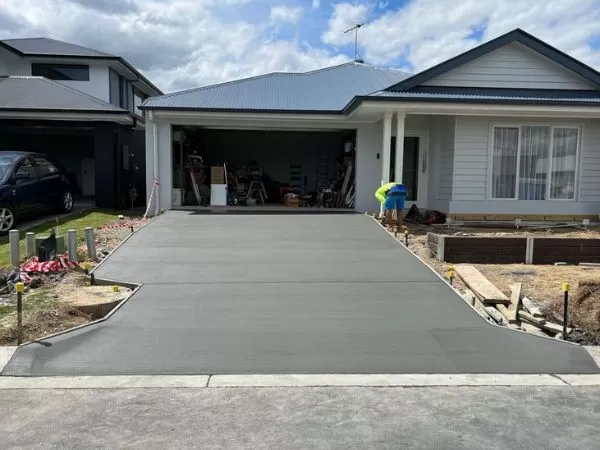
The crossover — sometimes called a vehicle crossing, a driveway crossing, or a “layback” if it’s the pre-formed kerb style — is the section of driveway between your property boundary and the road kerb. It sits on Council land, inside the road reserve, and it’s governed by the Road Management Act 2004.
Your driveway on your own land is yours. The crossover isn’t. That’s the whole distinction, and it’s why the permit exists.
When you need a permit
Cardinia requires a Works Within a Road Reserve consent for three scenarios:
- Constructing a new crossover — building where there wasn’t one before, on a new home or an existing house that never had a driveway.
- Altering an existing crossover — widening it, changing its position, replacing an old asphalt one with concrete, or moving it because your garage has moved.
- Adding an additional crossover — a second driveway to the same property, common on corner blocks or when adding a granny flat with its own vehicle access.
You also need the same consent for other work in the road reserve, including connections into Council drainage on private property and modifications to a Council stormwater pit — which catches people out when the driveway’s fall doesn’t work and the levels need adjusting at the pit.
If your work is entirely inside your boundary — replacing your driveway from the crossover inward, for example — you don’t need the road reserve consent. But you probably need a plumbing permit for the discharge, and possibly a building permit depending on what’s being demolished.
The fee: why it's $156.30, and why other sites are wrong
Cardinia charges $156.30 for the consent, payable on lodgement.
That figure isn’t a price Cardinia sets. It’s a statutory fee — 9.3 fee units under the Road Management (Works and Infrastructure) Regulations 2015, at the current fee unit value of $16.81. Which is why it lands on such an odd number, and why it moves every July when the fee unit is indexed.
Worth being blunt about this: several other Pakenham-area concreting websites quote figures that are demonstrably wrong. One popular site quotes “around $260 application fee plus a $1,500 refundable bond.” No such bond exists in Cardinia’s process. The fee isn’t $260. The figure on Council’s own application form is $156.30.
The same goes for the “range” quotes — “expect $200 to $350” — that appear on several sites. They’re guesses, and they don’t match the form. Check the form yourself: it’s on Cardinia’s website under Local Laws, Parking and Permits, titled “Consent to Undertake Works within a Road Reserve.”
[[MARKER — Cardinia’s published form is still dated 2025-26. If you’re reading this and the FY has moved, the fee is likely 2.75% higher (~$160.60). Call 1300 787 624 to confirm the current figure.]]
The $20 million insurance rule
This is the part that catches every owner-builder off guard.
To get the consent, the applicant must supply a Certificate of Currency for Public Liability Insurance showing $20 million. Cardinia’s form is explicit: the figure “must be shown as $20 million for all works.” Council also states plainly on the same form that home insurance is not Public Liability Insurance and does not cover these works.
No homeowner’s policy meets that threshold. Not a good one, not with an endorsement, not at all. The number sits above what any residential insurer offers.
Which means, in practice: you cannot legally pour your own crossover. Regardless of skill, regardless of ability, regardless of whether you built the driveway on your side of the boundary yourself. The permit requires a $20M PL certificate. A qualified contractor has to do the works.
It isn’t Cardinia being restrictive. It’s the standard Victorian road manager posture. Casey has the same requirement. So does every other council that manages a road reserve under the Act.
The insurance isn’t a formality. It’s the mechanism that decides who carries the cost when a kerb cracks, a pit lid breaks, or a footpath ends up at the wrong level. The contractor is required to reinstate any affected infrastructure to Council standards — and if that doesn’t happen, Council reinstates it and bills the contractor. The insurance is what makes that possible.
Timeline: how long the permit actually takes
Cardinia’s published turnaround is up to 28 business days from a complete application. That’s roughly six weeks calendar time.
Once approved, the consent is valid for six months. It can be extended once, by a maximum of three months.
Practical implications:
- If your driveway is on a builder’s schedule, lodge the consent as early as you can. Waiting until the slab is poured to think about the crossover is the most common mistake in the corridor.
- If you’re managing an owner-build, don’t send the consent in until your contractor has been chosen and can supply the Certificate of Currency — an incomplete application resets the clock.
- If your driveway job spans a summer, note the six-month validity. A consent issued in November may need an extension by May if there’s been weather or material delays.
The construction standard: EDCM 501
Cardinia publishes no vehicle crossing drawing of its own. Instead, Council directs contractors to the Growth Area Authority’s standard drawings, adopted across most Melbourne growth-corridor councils. For residential crossings, that’s EDCM 501 (single) or EDCM 502 (double).
The residential drawing calls for:
- 125 mm of N25 concrete
- SL72 mesh at 50 mm top cover, with 50 mm cover to all edges
- Over 50 mm of 20 mm class 3 crushed rock, mechanically compacted
- Minimum crossing width of 3,500 mm unless the approved plans say otherwise
- Grades between 1 in 50 and 1 in 10
- Light broom finish with edges and joints tooled after the broom is applied
- Slip resistance complying with AS 4586
One thing worth watching for: if a quote specifies SL82 mesh, that’s EDCM 503 — the heavy duty drawing, 4,000 mm wide, meant for commercial and industrial access. It isn’t the residential drawing. Specifying it doesn’t make your driveway better, it makes the quote look technical while pushing the cost up.
For coloured or decorative finishes in the crossover, minimum strength rises to 32 MPa and Council approval is required for the finish specifically. Plain N25 is only permitted where the finish is a standard broom.
Clearances: where the crossover is allowed to go
The other thing homeowners get wrong: the crossover doesn’t necessarily go where the garage is.
The drawing set requires:
- 7 metres between non-abutting crossovers, measured at the kerb
- 6 metres from an intersection tangent point, and clear of splitter islands
- 2 metres from a pram crossing
- 1 metre from fire hydrants, streetlights, service pits, traffic management devices, and your legal point of discharge
- 0.75 metres from a drainage pit — and inside that distance, a Class D pit lid is required
- Street trees: the tree protection zone, or 3 metres, whichever is greater
Street trees are the clearance that most often moves a crossover from where the owner wanted it. On established blocks — Beaconsfield especially, but Berwick and Officer Village too — the mature street tree in front of the property can push the crossover several metres one way or the other. Council weighs the encroachment against the tree’s retention value. Where removal is approved, the applicant pays for it and the replacement.
Where Cardinia sits compared to neighbouring councils
Cardinia’s $156.30 statutory fee is on the low end of what the corridor charges. Not because Cardinia is soft on compliance, but because Cardinia hasn’t stacked a council-set fee on top of the statutory line item.
City of Casey, next door, charges $364 non-refundable for its vehicle crossing permit. That figure buys:
- Council-issued drawings supplied with the permit
- 12 months of validity instead of six
- A mandatory pre-pour inspection — a hold point before you’re allowed to pour
Casey’s process is: apply, get approved, pay, box up, do not pour, book a pre-pour inspection with three business days’ notice, inspection passes, then pour. If the inspection fails, you fix it and rebook. If the second inspection still doesn’t match the drawings, the permit is cancelled and you reapply from scratch — the $364 doesn’t come back.
There are reasonable arguments for each model. Casey’s inspection catches non-compliant work before the concrete goes in, rather than after. Cardinia’s fee is consistent with the statutory framework and lower barrier. Neither is objectively better — but they’re different, and if you’re in Beaconsfield, where the municipal boundary literally runs through the suburb, which side of the creek you’re on decides which of these two processes applies to your build. Same suburb, two councils, $208 difference.
Common mistakes homeowners make
Five patterns we see repeatedly:
- Assuming the crossover is included in a “driveway” quote. Sometimes it is. Often it isn’t. Ask specifically. If the concreter can’t tell you the permit fee and the process, they haven’t costed it.
- Leaving the permit until after the slab is poured. By the time the driveway is ready to pour, the crossover permit should already be issued. A 28-business-day lead time isn’t something to discover late.
- Believing the “$260” or “$350” numbers online. Cardinia’s fee is $156.30. Any other figure is either wrong, or applies to a different council.
- Not checking clearances before deciding where the driveway goes. Street tree, drainage pit, or the neighbour’s crossover can all move your entry point several metres.
- Owner-building the crossover. Not permitted. Not because of skill — because of insurance. See above.
Getting the crossover done properly
What good process looks like, in order:
- Contractor visits the site and checks clearances before quoting
- Contractor lodges the road reserve consent with insurance certificate and sketch plan
- Cardinia processes the consent (up to 28 business days)
- Consent issued; crossover boxed up to EDCM 501
- Concrete poured, cured, finished
- Affected infrastructure reinstated to Council standard
The full detail on how the crossover fits with the driveway on your own land is on our vehicle crossings in Pakenham page. For the slab side of the job — reinforcement, site classification, joint design — see concrete driveway.
And if you’re on the corridor and want to talk to us specifically about your job, see concreters in Pakenham, or the concreters in Officer page for the estate covenant and finish requirements that apply if you’re on that side of the shire.