
Concreters in Officer
Officer is a Cardinia Shire suburb, and it’s the one where the Council issuing your driveway permit is physically in the suburb. Cardinia’s Civic Centre sits at 20 Siding Avenue — a five-minute drive from most of the newer estates, and closer than any competing PO Box.
Two things separate an Officer job from the rest of the corridor. What the council process actually looks like when you’re building in the suburb the council is in. And what your estate’s design guidelines require on the finish. This page covers both.
The council is at 20 Siding Avenue
Cardinia Shire’s Civic Centre is in Officer. Not in Pakenham. Not in a regional office. The council that issues your vehicle crossing consent is a short drive from your build.
Practically that means three things for an Officer job:
- The consent can be lodged in person. Cardinia accepts the Consent to Undertake Works Within a Road Reserve application form at the counter at Siding Avenue, by email, or by post to PO Box 7 Pakenham. For a straightforward job that’s a courtesy, not a difference. For a job with unusual clearances or a pit modification, being able to walk in and talk to a road reserve officer is worth having.
- Processing tends to be predictable. Cardinia’s published turnaround on the consent is up to 28 business days. In practice, Officer jobs move through the same pipeline as every other Cardinia job.
- The fee is what it is. Cardinia’s consent is $156.30, set as a statutory fee in fee units under the Road Management (Works and Infrastructure) Regulations 2015. Any Pakenham-area concreter quoting you $260 or a $200–350 range or a refundable bond has invented that number. It appears on Council’s own form.
If you’re on the boundary with Casey — some parts of Officer are — the crossing permit runs to a different set of rules. That’s the story on the concreter in Beaconsfield page, and it’s more common than Officer buyers realise.
The estates: what's built, what's building, and what's finished
Officer is Cardinia’s Urban Growth Area. If you bought a block in Officer in the last decade you’re almost certainly in a named estate with design guidelines registered on your title. The market has moved, though — and where you are in that cycle changes what the covenant requires and how strictly it’s enforced.
- Arcadia — developed by Satterley (not Lendlease, as some directories still list). Arcadia is now sold out, and homes are being completed on the remaining blocks. If you’re building in Arcadia now, you’re likely toward the end of the covenant enforcement period rather than the start.
- Timbertop, Estuary, Hamilton, Arena — other named estates through Officer. Each has its own developer and its own design guidelines. What they require on driveways varies estate to estate, stage to stage.
- Officer Town Centre precincts — mixed-use, higher density, different again.
None of these are things you should take at face value from a concreter’s website. Your title carries the actual rules. Send us your covenant document (or the design guidelines PDF the developer supplies) and we’ll match the quote to what your estate requires.
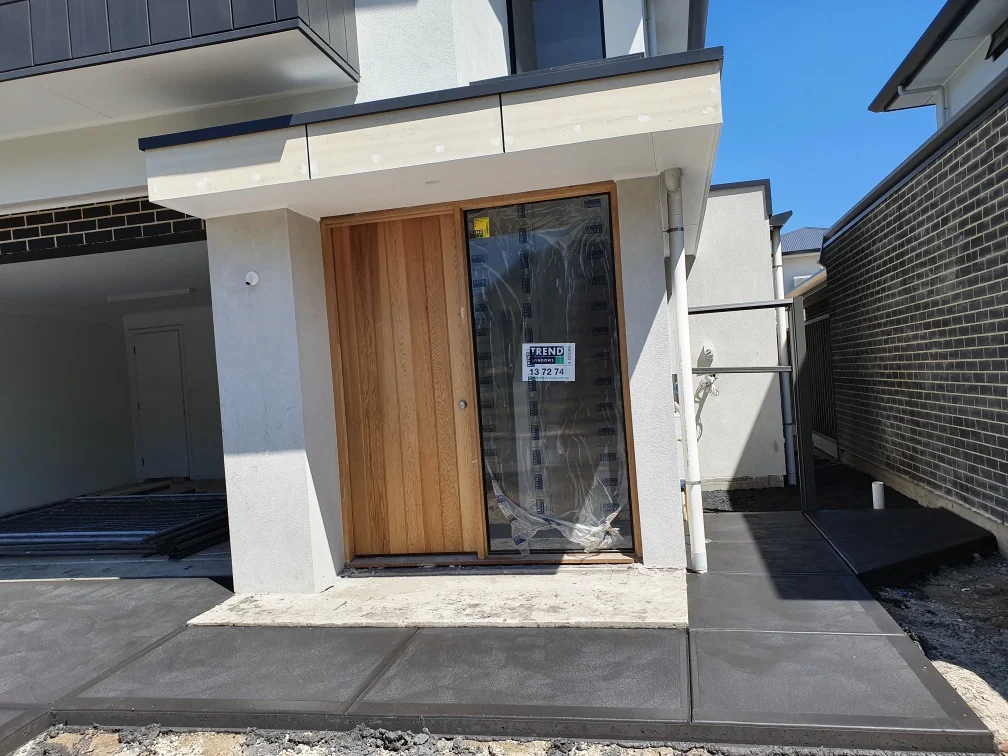
What estate covenants typically require on your driveway
Design guidelines on Officer titles commonly cover the driveway. The details vary by estate and stage, but the family of conditions we see is consistent:
- Decorative finish required at the front. Plain broom-finished concrete is usually not permitted on the visible section of the driveway. See decorative concrete for the finish families that meet this.
- Asphalt not permitted. Almost universal across the corridor estates.
- Completion within a set period. Often 12 months from occupancy, sometimes longer, occasionally shorter. Missing the deadline can trigger developer enforcement.
- Coloured or exposed aggregate is the common default. Exposed aggregate is the most common finish chosen to comply, followed by coloured concrete with a decorative element.
Two things worth being plain about. First, these are typical, not universal — your title has the actual rule, and covenants vary block by block and stage by stage. Second, these are a legal condition on your title, not a suggestion. Pouring the wrong finish and hoping the developer doesn’t notice is a bet, not a strategy.
The new-estate driveway: what actually goes into the ground
An Officer driveway is a specific job. New estate, graded block, footpath and kerb already in, discharge point at the street. What that means for the build:
- The subgrade has been driven over by every trade since the frame went up. Compacted — but not the way an engineer means compacted, and often churned in patches. Base preparation on new-estate work isn’t optional and it’s a real line on the quote.
- The falls are the driveway’s job. Estates hand you a graded flat pad. The driveway carries the fall from your garage door out to the kerb, set to your legal point of discharge, at a minimum 1 in 50 gradient away from the building.
- The vehicle crossing ties into a formed kerb. On some blocks the developer has poured a stub or a “layback” that needs to be broken back or extended to meet the driveway properly — that’s part of the crossover job, and it’s what the road reserve consent covers.
- Send your soil report. You already have one — it came with your slab documentation. Reinforcement, base depth and jointing on your concrete driveway come back designed against the actual site classification instead of a corridor-wide guess.
Neighbouring suburbs
Pakenham is the other Cardinia suburb doing volume work — and the wider corridor site covers what we build across every Cardinia address, including the ones the council rules-set applies to. If you’re on the boundary near Beaconsfield — some of Officer’s western edge is — check whether you’re actually in Cardinia or in Casey before you accept any quote, because the concreter in Beaconsfield page explains a $200 permit difference that catches out both concreters and homeowners.
For the rest of what we build, see concreters in Pakenham.
Send your address, your covenant (or the developer’s design guidelines), and your soil report. We’ll come back with the finish options that meet your estate’s requirements, the driveway specification designed to your site class, the crossover process for your side of the shire, and the timeline — not a per-square-metre number that hides half the job.